


Reference. 94289111X
Danish disposable straps for arms and legs. Various sizes.
Danish girths represent a superior option for healthcare institutions seeking to optimize patient safety, operational efficiency, and regulatory compliance in their surgical procedures.

Secure payment
Description
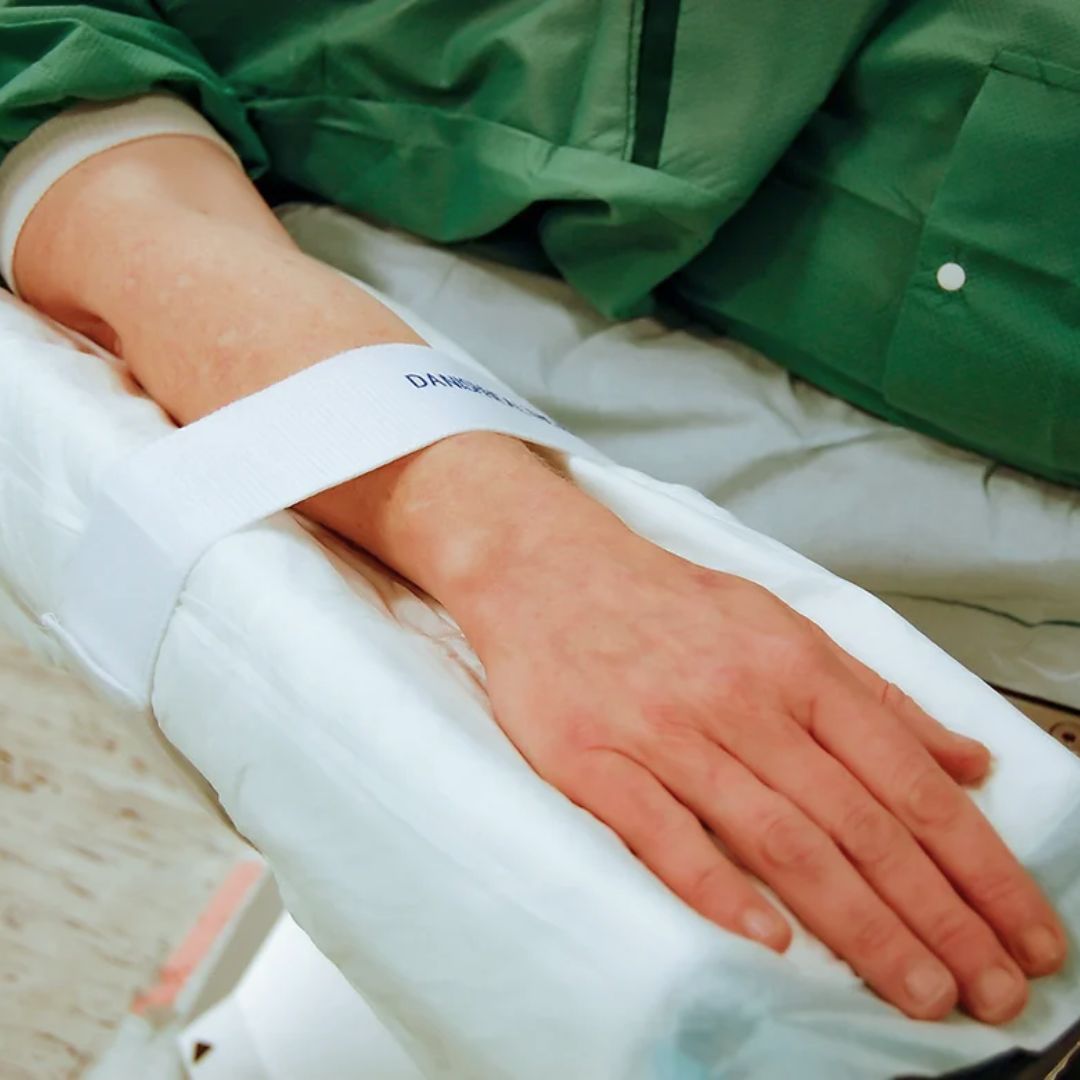
Danish straps for arms and legs provide an innovative and safe solution for securing patients during surgical and anesthetic procedures. Designed by nursing professionals, these straps effectively supply the common limitations of their market counterparts.
Features:
- Adjustable length to fit different patient sizes.
- Disposable design to reduce the risk of infection.
- Enhanced safety. The absence of metal minimizes the risk of injury to both patients and medical staff.
- Infection prevention. Single-use significantly reduces the risk of transmission of MRSA and other nosocomial infections.
- Its flexible and soft design ensures maximum comfort for the patient during the procedure.
- Latex-free manufacturing, ideal for allergic patients.
- Flexible and soft material, without metal components.
- Being disposable, they eliminate the need for washing and disinfection, saving time and resources.
- Registered under the MDR, ensuring the highest standards of quality and safety.
Available sizes:
- XS: 5 x 60 cm (Ref. 942891112)
- S: 5 x 70 cm (Ref. 942891111)
- M: 5 x 85 cm (Ref. 942891110)
- L: 5 x 120 cm (Ref. 942891120)
Proper placement:
For the upper extremities:
- The belt is placed under the armrest and over the forearm.
- It is fixed with velcro in the middle of the forearm.
For the lower extremities:
- The belt is placed under the leg support and over the calf.
- It is fixed with velcro in the middle of the calf.
In both cases:
- Medical staff must ensure that blood circulation is not restricted.
- The maximum pressure applied should not exceed 50 kg (500 newtons).
- The straps are designed exclusively for this purpose and should not be used for other purposes.
Intended use in the following surgeries:
- Nervous system.
- Endocrine organs.
- Eyes and ocular area.
- Ear, nose and larynx.
- Lips, teeth, jaws, mouth and throat.
- Cardiac and main intrathoracic blood vessels.
- Respiratory tract, thorax, mediastinum and diaphragm.
- Breast.
- Digestive organs and spleen.
- Urinary tract, male genitals and retroperitoneal tissue.
- Female genitals.
- Obstetric surgery.
- Musculoskeletal system.
- Peripheral blood vessels and lymphatic system.
- Skin and subcutaneous tissue.
- Minor surgical procedures.
- Endoscopies through natural and artificial orifices.
Features:
- Adjustable length to fit different patient sizes.
- Disposable design to reduce the risk of infection.
- Enhanced safety. The absence of metal minimizes the risk of injury to both patients and medical staff.
- Infection prevention. Single-use significantly reduces the risk of transmission of MRSA and other nosocomial infections.
- Its flexible and soft design ensures maximum comfort for the patient during the procedure.
- Latex-free manufacturing, ideal for allergic patients.
- Flexible and soft material, without metal components.
- Being disposable, they eliminate the need for washing and disinfection, saving time and resources.
- Registered under the MDR, ensuring the highest standards of quality and safety.
Available sizes:
- XS: 5 x 60 cm (Ref. 942891112)
- S: 5 x 70 cm (Ref. 942891111)
- M: 5 x 85 cm (Ref. 942891110)
- L: 5 x 120 cm (Ref. 942891120)
Proper placement:
For the upper extremities:
- The belt is placed under the armrest and over the forearm.
- It is fixed with velcro in the middle of the forearm.
For the lower extremities:
- The belt is placed under the leg support and over the calf.
- It is fixed with velcro in the middle of the calf.
In both cases:
- Medical staff must ensure that blood circulation is not restricted.
- The maximum pressure applied should not exceed 50 kg (500 newtons).
- The straps are designed exclusively for this purpose and should not be used for other purposes.
Intended use in the following surgeries:
- Nervous system.
- Endocrine organs.
- Eyes and ocular area.
- Ear, nose and larynx.
- Lips, teeth, jaws, mouth and throat.
- Cardiac and main intrathoracic blood vessels.
- Respiratory tract, thorax, mediastinum and diaphragm.
- Breast.
- Digestive organs and spleen.
- Urinary tract, male genitals and retroperitoneal tissue.
- Female genitals.
- Obstetric surgery.
- Musculoskeletal system.
- Peripheral blood vessels and lymphatic system.
- Skin and subcutaneous tissue.
- Minor surgical procedures.
- Endoscopies through natural and artificial orifices.
Alternative products

Danish disposable straps with foam for arm and leg, 44 x 5 cm
(100 units)303,00€(366,63€ VAT INCLUDED)
Danish disposable straps for the upper part of the legs with integral...
(100 units)771,90€(934,00€ VAT INCLUDED)
Danish disposable girths for the lower part of the legs, 30 x 160 cm
(25 units)562,33€(680,41€ VAT INCLUDED)
Danish disposable straps with loop for arm and leg, 44 x 5 cm
(100 units)313,30€(379,09€ VAT INCLUDED)
Disposable Danish straps for the abdomen. Various sizes
(50 units)508,40€(615,16€ VAT INCLUDED)
Danish disposable straps for the torso, 25 x 200 cm
(25 units)690,98€(836,08€ VAT INCLUDED)