


Oxygen Mask Guide: Types, Flows, and Clinical Criteria
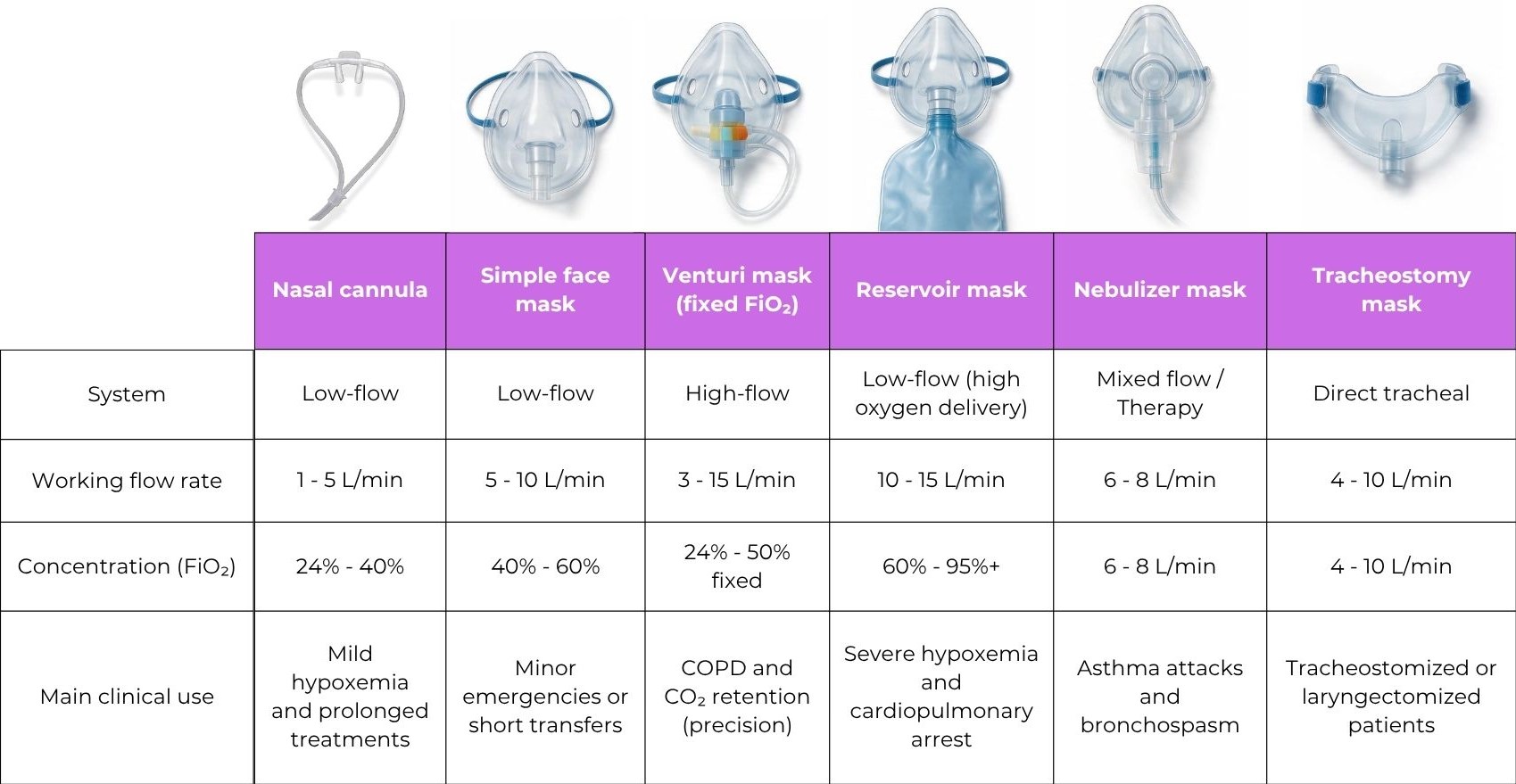
Comparative table of the 6 devices
1. Glasses or nasal cannulas (First step)
This is the most common method for administering low-flow basal support without interfering with the patient's routine.
-
Operation: Two soft tips are placed in the nostrils, resting the tubing on the cheeks.
-
Parameters: It works from 1 to 5 L/min with an estimated concentration of 24% to 40%.
-
Clinical advantage: It allows speaking, coughing, eating, and drinking normally, ensuring excellent tolerance.
2. Simple facial mask (Without regulation)
Made of transparent medical-grade PVC, it anatomically covers the nose, mouth, and chin.
-
Operation: The body of the mask acts as a small mixing chamber before inhalation.
-
Parameters: Flows from 5 to 10 L/min (never below 5 L/min to avoid CO2 reinhalation) and FiO2 up to 60%.
-
Clinical advantage: Ideal for moderate respiratory conditions, observation stays, or post-surgical resuscitation.
3. Venturi type mask (Fixed and adjustable concentration)
It is the undisputed reference when it is necessary to guarantee an exact inspired fraction of oxygen independent of the patient's breathing.
-
Operation: It takes advantage of the Bernoulli principle; oxygen under pressure enters through a narrow hole, dragging ambient air in a predetermined fixed proportion.
-
Parameters: It incorporates color-coded adapters or a rotating selector ring to set exact values (24%, 28%, 31%, 35%, 40%, and 50%).
-
Clinical advantage: Essential in patients with chronic respiratory failure or COPD, where an excess of oxygen could nullify the ventilatory stimulus.
4. High concentration mask with reservoir bag
The non-invasive oxygen therapy device capable of delivering the highest concentration of oxygen.
-
Operation: It incorporates a connected storage bag and a valve system that prevents mixing with exhaled air.
-
Parameters: It requires a flow of 10 to 15 L/min to keep the bag permanently distended, achieving concentrations of 60% to 95%+.
-
Clinical advantage: First intervention equipment in emergency kits, polytrauma, carbon monoxide poisoning, and shock.
5. Nebulizer mask (Aerosol therapy)
Specifically designed with a lower connection suitable for attaching a liquid medication dosing cup.
-
Operation: The continuous gas flow pulverizes the drug into breathable microparticles that reach directly to the lower airways.
-
Parameters: It is usually calibrated at flows of 6 to 8 L/min to achieve homogeneous aerosolization.
-
Clinical advantage: Direct administration of bronchodilators, mucolytics, or corticosteroids during acute asthma or bronchitis crises.
6. Tracheostomy mask or bell
Ergonomic curved device designed to specifically fit the neck over a tracheotomy cannula.
- Operation: It is adjusted by a cervical elastic band, supplying oxygen and humidified steam directly to the stoma.
-
Parameters: 360° rotating connector for standard 22 mm lines, compatible with nebulization or high flow systems.
-
Clinical advantage: Prevents the drying of secretions and protects the tracheal mucosa in tracheostomized or laryngectomized patients.
Do you need to equip your center or clinic with oxygen therapy material?
Explore our category of Nasal glasses and masks to discover our complete catalog of facial masks, multiconcentration Venturi kits, nasal cannulas, and nebulization systems with CE marking and guaranteed medical quality. If you have doubts about compatibilities, volume orders, or need personalized technical advice for your health center, contact our team of specialists and we will help you choose the right solution.

